
+385 (1) 35 35 200P.tesi - Cuma 09:00 - 18:00
Counter-Drone & Electronic Warfare Systems: Defending the Modern Airspace
Counter-drone and electronic warfare systems play a critical role in modern security by controlling the electromagnetic spectrum and disrupting unmanned aerial threats. These technologies enable precise, non-destructive protection of sensitive airspace across military, civilian, and industrial environments.
Modern Counter-Drone and Electronic Warfare Technologies
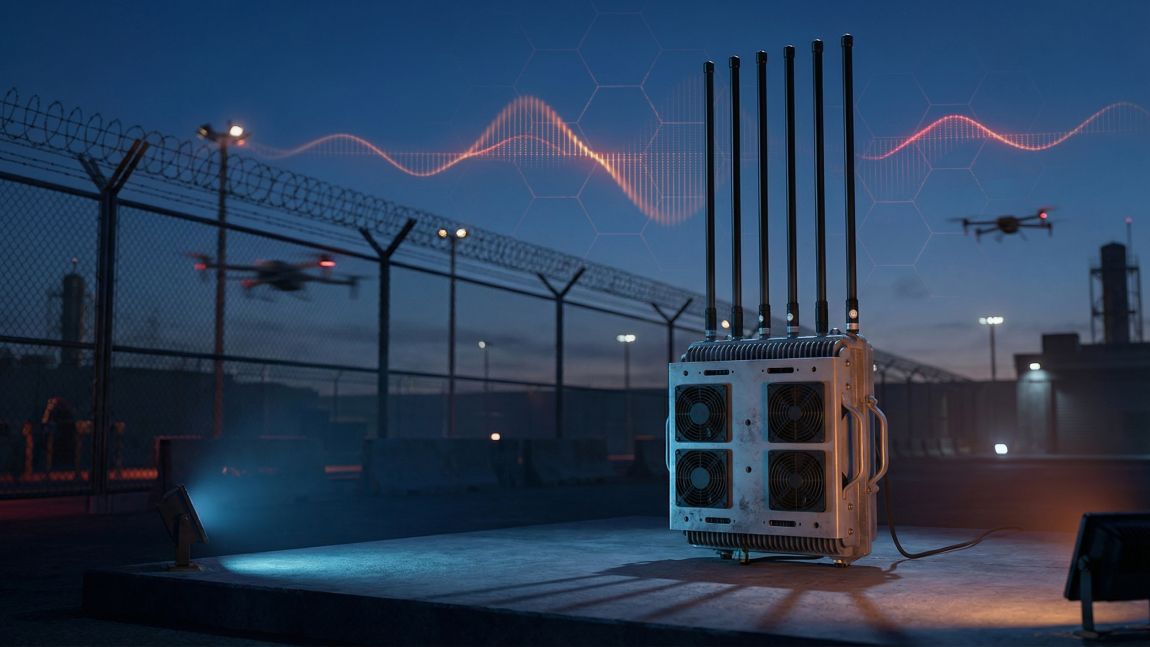
The rapid proliferation of drones has fundamentally altered the security landscape. What was once a controlled and predictable airspace is now populated by small, agile, and often anonymous unmanned aerial systems capable of surveillance, disruption, and hostile action. In response, counter-drone and electronic warfare systems have emerged as essential tools for protecting sensitive environments in the 21st century.
Unlike traditional security solutions, these systems operate primarily in the electromagnetic domain—where control of signals, frequencies, and data links determines who truly owns the airspace.
From Physical Defense to Electromagnetic Control
Conventional air defense systems were designed to counter aircraft and missiles operating at high altitudes and long ranges. Drones, however, operate low, slow, and close to their targets. They are difficult to detect visually, acoustically, or with legacy radar systems.
Counter-drone and electronic warfare technologies address this challenge by shifting the focus from physical interception to electromagnetic dominance. Instead of destroying the threat, these systems aim to disrupt the signals that allow drones to function—navigation, communication, and control.
This approach enables precise, scalable, and often non-destructive mitigation, making it suitable for both military and civilian environments.
What Defines a Counter-Drone System?
A modern counter-drone system is not a single device, but an integrated set of capabilities designed to manage the entire threat lifecycle. At its core, it typically includes:
Detection and awareness
Systems monitor the electromagnetic spectrum to identify drone-related signals and distinguish them from background noise. Early detection is critical, as response time at low altitudes is extremely limited.
Identification and classification
Not every drone represents a threat. Advanced systems analyze signal characteristics, flight behavior, and communication patterns to determine the type of drone and its potential intent.
Electronic mitigation
Once a threat is confirmed, electronic warfare techniques are used to disrupt or override the drone’s operation—without relying on kinetic force.
The Role of Electronic Warfare in Drone Defense
Electronic warfare (EW) plays a central role in counter-drone operations because drones are fundamentally dependent on electronic signals. Remove or manipulate those signals, and the drone becomes ineffective.
Key EW techniques used in counter-drone systems include:
Signal jamming
By transmitting targeted interference across specific frequency bands, jamming systems can sever the communication link between the drone and its operator. This may force the drone to land, hover, or initiate a fail-safe return.
Navigation interference
Many drones rely heavily on satellite navigation systems. Disrupting or manipulating these signals can cause loss of positional awareness, preventing accurate flight or mission execution.
Command and control denial
Advanced systems focus on disrupting uplink and downlink communication channels, cutting off real-time control and data transmission.
These techniques allow operators to neutralize threats with precision, reducing the risk of collateral damage—an essential requirement in urban, industrial, and critical infrastructure settings.
Fixed, Mobile, and Portable Solutions
Counter-drone and electronic warfare systems are deployed in various configurations depending on the operational environment.
Fixed systems
Installed at permanent sites such as airports, power plants, government facilities, or military bases, fixed systems provide continuous, automated protection across defined airspace sectors.
Mobile systems
Vehicle-mounted or rapidly deployable systems are used to protect temporary locations, convoys, or field operations, offering flexibility without sacrificing capability.
Portable and handheld systems
Backpack-mounted units and anti-drone guns allow security personnel to respond quickly to localized threats, particularly during events or tactical operations.
This modularity ensures that counter-drone capabilities can scale with the threat level and mission requirements.
Beyond the Battlefield: Civil and Commercial Applications
While electronic warfare was once confined to military doctrine, counter-drone EW systems are now increasingly relevant in civilian and commercial contexts.
Airports face disruptions from unauthorized drones entering controlled airspace. Energy providers must protect substations and pipelines from surveillance or interference. Event organizers, logistics hubs, and industrial facilities all require reliable protection against low-altitude aerial threats.
In these environments, non-destructive electronic mitigation is often the only viable option—highlighting the importance of precise, controlled EW solutions.
Integration Is the New Standard
Standalone counter-drone devices are no longer sufficient. Effective defense now requires integration with broader security ecosystems, including surveillance systems, command centers, and response protocols.
Modern counter-drone and electronic warfare systems are designed to integrate seamlessly with existing infrastructure, enabling centralized monitoring, coordinated response, and data-driven decision-making.
This integrated approach transforms counter-drone technology from a reactive tool into a strategic security asset.
Looking Forward
As drones continue to evolve—incorporating autonomy, encrypted communications, and coordinated swarm behavior—counter-drone and electronic warfare systems must evolve alongside them. The future of airspace security will be defined by adaptability, signal intelligence, and the ability to operate across multiple layers of the electromagnetic spectrum.
Defending modern airspace is no longer about physical barriers or line-of-sight detection. It is about controlling signals, denying hostile capabilities, and maintaining dominance where threats are no longer visible—but always present.